We were posing for a group photo at Apo Island when this sea turtle surfaced to breathe and photo-bombed! This shallow area in Apo Island, Negros Oriental, Philippines is a feeding ground for sea turtles. Just like what my friend Genesis said, this is a reminder that humans and creatures like this gentle pawikan can co-exist.
Did you know that?
Green sea turtles are “endangered” and it is illegal to collect, harm, or kill them.
Apo Island in the Philippines is one of the world’s best known community-managed Marine Protected Area.
Sea turles gently foraging on seagrass, seemingly unafraid– I’ve been to Pandan Island in Sablayan, Occidental Mindoro, Philippines thrice already, and this is a sure to see.
Green sea turtles (Chelonia mydas) are named because of the greenish color of their fats. They’re herbivores and feed on seagrass!
They are endangered because of the threats of harvesting their eggs, hunting and loss of their nesting beach sites.These turtles are resident to Pandan Island. The island being a marine protected area allow the turtles to live “safely” in the area.
The world got mind blown when Sanrio said that Hello Kitty is not a cat. “She’s a cartoon character. She is a little girl. She is a friend. But she is not a cat. She’s never depicted on all fours. She walks and sits like a two-legged creature.” Yes, Hello Kitty’s expressionless mug which started on a coin purse in in Japan in 1974 is now part of the global popular culture and she has been featured on countless toys, sculpture, underwear, a song by Avril Lavigne and dress worn by Lady Gaga and a lot more.
“Hello Kitty works and is successful partly because of the blankness of her design,” Christine Yano, author of “Pink Globalization: Hello Kitty’s Trek Across the Pacific,” says. “People see the possibility of a range of expressions. You can give her a guitar, you can put her on stage, you can portray her as is.”
And imagine walking into a room filled with Hello Kitties of all sort blankly staring at you. Thanks to Anna Karina Lopez-Tan for inviting us into her Hello Kitty Meowseum 😉
Rain-drenched, hiking stick on one hand, some goods on the other, and backpacks covered in improvised plastic raincoat, we trekked from the Saddle Point down the muddy mountain ridge. The night before, the seven of us were able to fill a jeepney with more than 10 boxes of food, sanitary supplies, gifts and books (plus one whole set of encyclopedia), transported them overnight via a commuter bus from Manila to Banaue, Ifugao , then another jeepney through a rough, muddy, winding road and then carried them by hand. Good thing some local mothers and kids helped us.
At a bend in the trail, the clouds the same level with us in the horizon, the picturesque amphitheater of the Batad Rice Terraces greeted us.
We were originally planning for a highschool friends get together Christmas party, when we thought of making it something more special. The idea of doing an outreach popped up. And after a few days of planning and soliciting funds, goods and support, we found our way into one of the UNESCO World Heritage Site.
The Outreach
We were still preparing, but the kids were already excited, playing while eagerly waiting for us..Wrapping the toys!Shopping for the family package: bihon, sugar, coffee, sardines, soy sauce, vinegar, juice, cheese spread, TINAPA, salt and soap.We personally prepared and cooked the food. Our menu: spaghetti, hotdogs, sandwich, and fruit salad & chocolate drink, typical for a kids party but not so typical in this remote area.Games! Longest line. Photo by RulaWe also donated books for their library.What was so touching was when the kids themselves presented songs and thanked us. We called the outreach Project Imi, from the Ifugao work to smile. Indeed, what was so rewarding was to see the smiles in the children’s faces.
Thanks to our generous friends and sponsors, Unilever and Magnolia, we were able to hold a party for more than 60 Batad kids. Thanks to Teacher Cathy and the parents who helped us. To Ka Rene for providing the contacts and to Mang Ramon of Ramon’s homestay.
This year, I’m going back to Banaue to another Igorot community in Ducligan. I invite you to give smiles and help us with our Project Lingap 😉
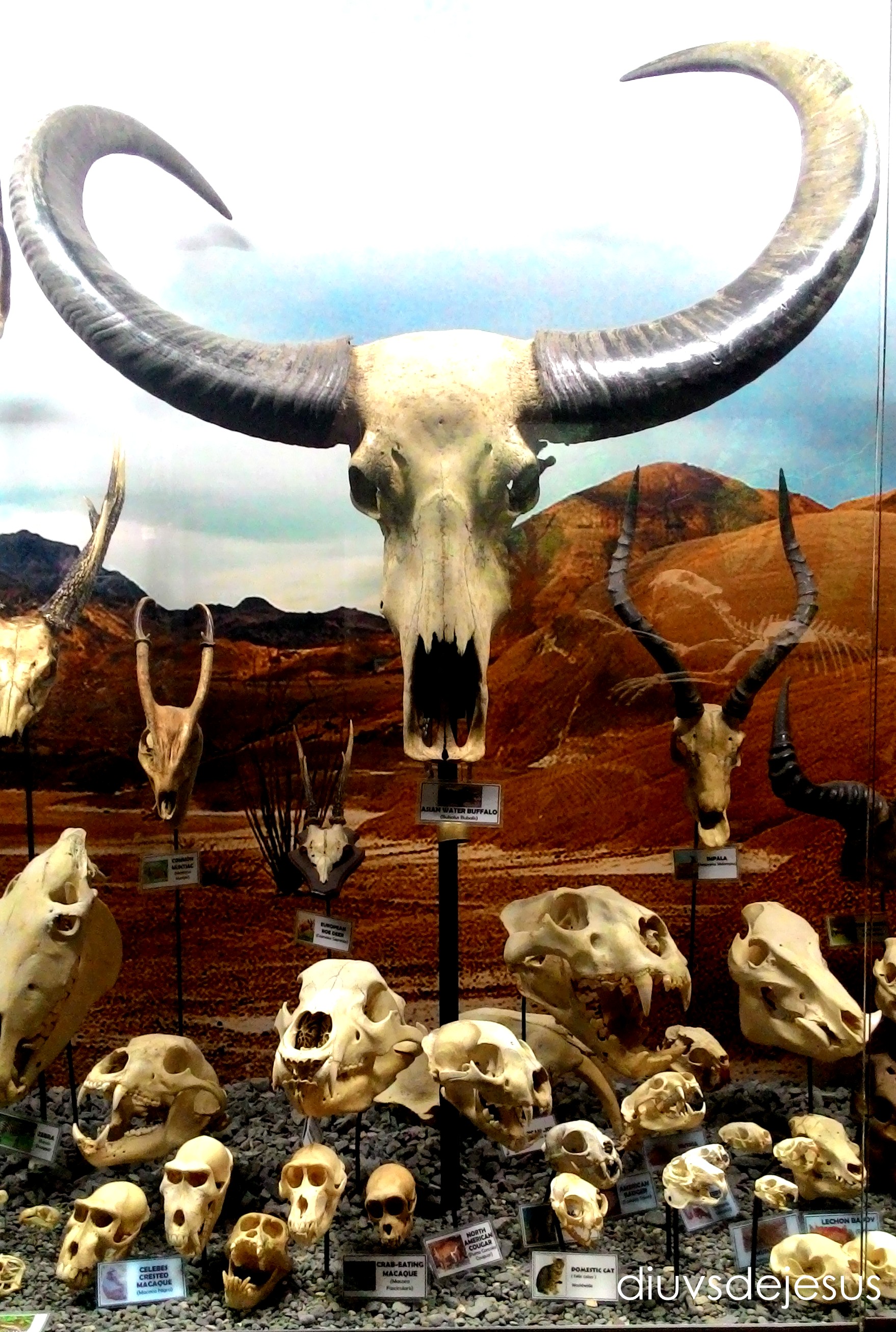
It’s like a trip to the zoo, but instead of seeing them in the flesh, all of them are in the bones, preserved and mounted. From domestic dogs, cats, cows & horses to wild monkeys, hornbills, snakes & crocodiles, to sea creatures like turtles, fish, dolphins & whales, the D’ Bone Collector Museum features a collection of more than 200 skeletons. These animals are showcased in different themed environments like plains, tropical forests, shallow seas and coral reefs. The bones mostly came from the collections of Darrell Blatchley, an American who has a Filipino heart, who had been collecting them since he was young. Some were donated.
different skullsdolphinjaw of a 41-foot sperm whale
What’s interesting are the stories behind each skeleton, like a racing horse that was dug up from its grave, many animals that died due to diseases, or several dolphins and whales that got beached and died. “Deaf ears” a pygmy killer whale was found with ruptured eardrums, most likely due to dynamite fishing. “Sad” a spotted dolphin got stranded with its calf “Happy”. “Sad” died of dehydration and starvation, but “Happy” survived and was later fetched by his pod of dolphins. Many of the dolphins and whales were found with plastic bottles and caps in their gut.
cause of death: plastic bottle blocking intestinesfetus died with its mother
Aside from preserving the dead specimens, the museum actively engages in conservation through education and rescue of animals. They plan to conduct workshops and also engage with government agencies like BFAR and the National Museum. It’s actually not just a fancy collection; it helps raise awareness for environmental protection.
I asked, “From a former president’s point of view, how do we move on with the goals of the ASEAN (Association of Southeast Asia) and BIMP (Brunei, Indonesia, Malaysia, Philippines) , given the growing political , territorial conflicts in the West Philippine Sea or South China Sea?”
Former Philippine President Fidel V. Ramos, called me in front, we took a selfie in front of media men, and asked me to repeat my question.
“We are all Asians,” he said. “One family. Ordinary Chinese people, the Filipino people, the Indonesians, Malaysians and the rest of Southeast Asians do not want World War III to happen.” He proposed to world leaders to stop their arms buildup but instead set up a common task force for enforcement of the law, safe and open navigation, search and rescue, and preparation for natural disasters. He said that the world’s problems now are poverty, terrorism, epidemic diseases, and climate change. “If we live together, as long as we don’t want war, this world will be a beautiful place to live in, even in the next generations.”
He looked at me and asked, “Nagbabasa ka ba ng Biblia? Nandoon lahat yun, (from) Genesis, the first book (to) Revelations, the last book. Pag-aralan mo sinabi ko.” (Do you read the Bible? It’s all there, from Genesis to Revelations. Study what I said).
This was during the 2nd BIMP- & IMT-GT Business Leaders’ Conference, October 23, 2014 at Davao City organized by the Mindanao Development Authority. For details check http://www.eagaimtfair2014.com
Bud Bongao from the beach. Its plateau shape is a landmark for the seafarers of the Sulu-Celebes seas.
The southernmost mountain in the Philippines, only at 422 meters above sea level, Bud (Mount) Bongao is a must climb when you’re in Tawi-Tawi.
BUD BONGAO’S GUARDIANS. Little long-tailed macaques (Macaca fascicularis) waiting for bananas!
As a “right of passage”, you should give offerings (bananas!) to the expectant guardians of Bud Bongao (though ecologically is not really good. Once they detect you, they will congregate and can be aggressive. They will accompany you on your hike up.
Together with our Datu friend, we entered one of the Tampats.
The mountain is a religious site for our Muslim brothers. As you reach the peak, you will see 3 Tampats or shrines. The shrines are said to be tombs of a priest and/ or an ancient royal family.
The peak gives you an astonishing view of the Celebes Sea, the islands of Sanga-Sanga, Sibutu and Simunul and even Sabah on a clear day.
Most people would party with family and friends but this year, I decided to celebrate my birthday underwater, with the cuttlefish, mandarins, seahorses and thresher sharks in Malapascua.
I felt a mix of emotions- anxiety and excitement- about going on a solo backpacking adventure on my birthday. There was a missed flight and long bus and boat rides but these were all worth the adrenaline rush and serenity I found in the island paradise.
Malapascua, a silent charming island north of Cebu, is a haven for beach lovers and scuba divers. The white sand, tranquil waters, vivid underwater life and year-round sightings of thresher sharks provide livelihood for most of the islanders.
Monad Shoal
Each dawn, as the sun peeks from the horizon and paints the sky pink and blue, thresher sharks rise into the cleaning stations of Monad shoal. In the shallower parts (24-30 meters) of the sea mount, pelagic thresher sharks (Alopias pelagicus) get cleaned by cleaner fishes for parasites in their skin. There is nowhere else in the world you can get front row seats to this live NatGeo moment.
Immediately after we positioned ourselves in the viewing point, a thresher hovered 3 meters in front of me then swam back into the blue. He was the first to greet me.
Gato Island
We had our afternoon dives at Gato Island, a supposedly Marine Protected Area (they’re having problems on enforcement against illegal fishing). The underwater of this rocky island and its caverns are hiding places for reef and bamboo sharks and other interesting macro life.
Lighthouse Reef
We were too late to witness the courting rituals of mandarin fishes which happen at dusk. Nevertheless, we saw some of these creatures sleeping in the safety of Acropora beds. Night diving was like a game of Mystery Case Files, where we looked for critters with our flashlights. We spotted seahorses, crabs and pencil urchins.
There is still a lot to see in Malapascua. Apart from the dive masters, I was the only Filipino diver in all the dive teams during my visit. I envy the foreigners who stay there for weeks, and even months to explore more of Malapascua and the Philippines. I look forward to more Filipinos seeing and experiencing the beauty in our backyards. And I also look forward to more people appreciating and protecting our environment.
We had to be creative. Before plunging into the shallowest portions of the Benham Rise, the Philippines’ newest territory, we always deployed GoPro cameras with a dive computer, tied to a rope and a sinker to check what’s beneath the Pacific waters.
One morning, in one of the stations, a whale shark rose and stayed with our ship for several minutes and we caught it on camera!
The whale shark (Rhincodon typus) , locally known as butanding, is the largest fish on earth. Yes, it is a fish, not a whale. Though widely distributed in tropical waters, it is considered “vulnerable” by the IUCN. Though fishing and selling of whale shark is prohibited in the Philippines, it is still being hunted in some parts. Also, emerging threats to whale sharks are irresponsible or unsustainable tourism practices.
** I am one of the team of Filipino scientists who first dived to see what’s in the waters of Benham Rise.
I want to share my insights on my recent travel in Taiwan that, I think, will help make a better Philippines.
1.Efficient transportation system
Imagine no long lines and squeezing yourself in just to ride the MRT. Taipei runs on an extensive network of trains. You can reach almost all destinations via train or ride their disciplined buses as an alternative option. Towns and cities outside Taipei can be reached through high speed trains in less than 2 hours. Payment is automated via EasyCard which can also be used to buy food from any 7-11 store.
The Philippines’ Department of Transportation and Communication is eyeing for a Bus Rapid Transit (BRT) system for Metro Manila, and hopefully it will change the metro scene. I think the Philippines has to invest more in efficient mass transport systems than building new roads that attract more traffic.
2. Discipline
It’s not that Filipinos aren’t disciplined, but I think these observations from Taiwan will greatly improve our way of life:
People properly line up in train stations. No pushing. There are Priority seats for the elderly, pregnant and disabled. Buses load and unload in designated stations. People clean up after eating in fast-food restaurants. Trains and buses leave and arrive on time. When crossing the streets,people use only the pedestrian lanes on a green signal.
3. Caring for the environment
More than 50% of Taiwan’s land area is forestland. The capital city Taipei is interspaced with greenspaces. The rivers are lined up with parks. They have educational signs for wildlife, plants and trees inside the parks and around the city. And it’s so hard to find trash and garbage bins in the city. What’s so cool and hopefully we’ll adopt in the Philippines is the U-bike rental system. You can rent a bike in one station and return it in another rental station.
Imagine Pasig River clean, with green parks along its banks and boating and hanging bridge for tourist and pedestrians. (photo taken at Xindian, Taipei)
Rent a U-bike in one station and leave it in another.
4. Tourist Friendly
Minus the communication barrier (which I think is the downside of Taiwan), the country is generally tourist friendly–so easy to go around. Aside from the efficient transport systems, they have free maps and Wifi at the airport, train and bus stations, and tourist destinations. Even without asking, several Taiwanese approached me and offered help to show me directions. And tourist destinations are well maintained.
Hope for the Philippines
With the Philippines’ longer history, rich culture and nature, I believe that we have high potentials to go up. Add to that the Filipino hospitality, perseverance and optimism despite negativities and diligence. I believe we can be better, if not, be the best.




 adventures ni kulot